
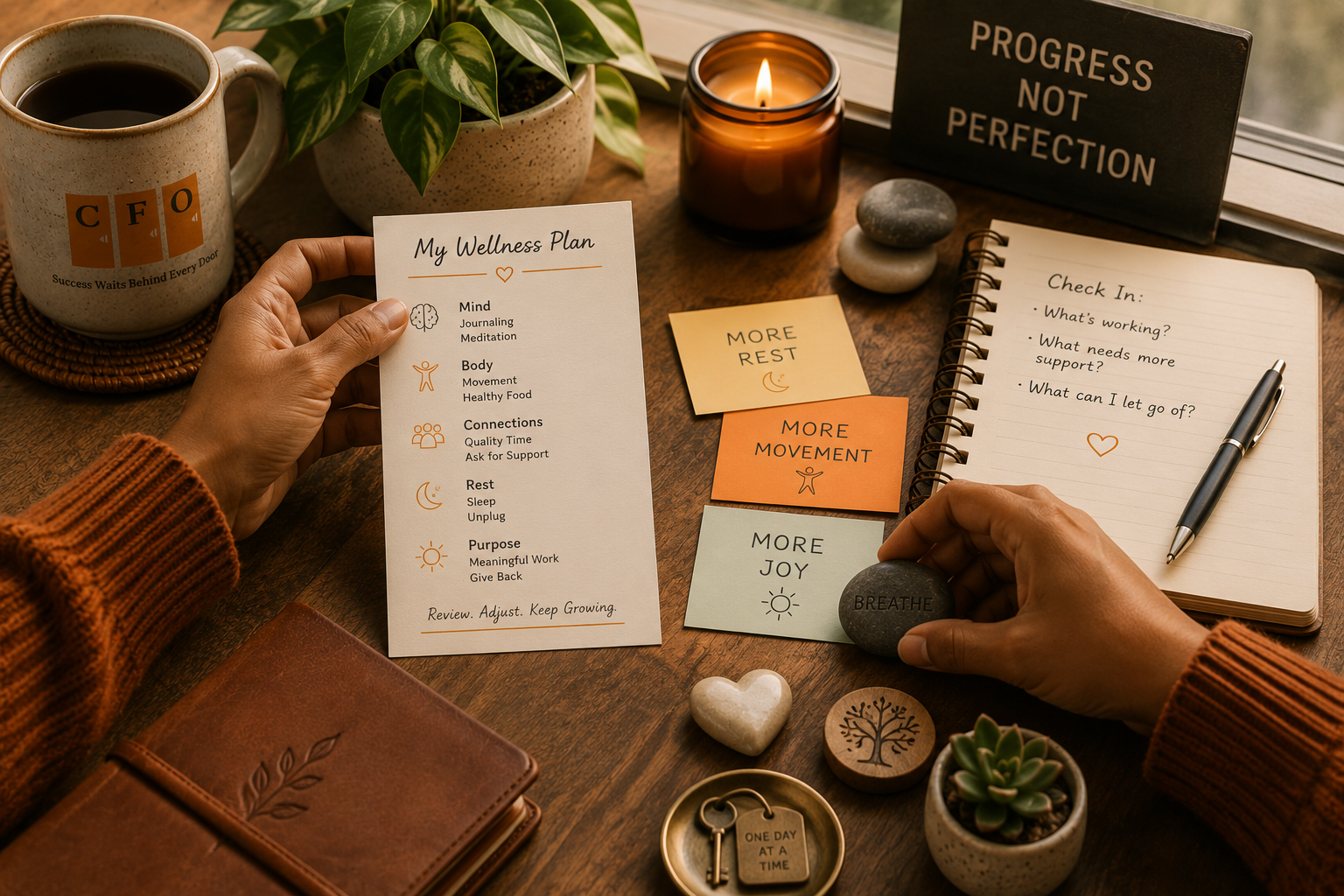
Your Toolbox Is Never Finished
Here’s something that would have saved me a lot of grief if someone had just said it plainly: a wellness plan is never done.
You don’t build it once and file it away. Instead, you keep it the way you keep anything you use a lot — you fix it, you swap parts, you toss what broke. A toolbox you never open stops being useful. But a toolbox you keep tending grows with you.
And that’s good news, even if it doesn’t sound like it at first. It means we don’t get it wrong. There’s no final version to fail at. There’s only the version you have now, and then the next one.
Letting go of old tools is part of the plan
Sometimes a tool just stops working.
Something that used to help doesn’t anymore. You change, and so does your life. Or maybe you’ve done that thing so many times it’s gone flat. This happens to everyone, and it doesn’t mean your old tool was never any good.
So when a tool stops working, cross it off. That’s maintenance. In fact, APPR tells you plainly that you can drop things when they stop helping, and add new things you want to try. The plan changes by design.
And because you’re different this year than last year, your toolbox can look different too. The plan should keep up with you, not hold you to who you used to be.
The same tool, two different jobs
Here’s the tricky part, and I want to be honest about it.
The same tool can help you one day and numb you the next.
For example: scrolling your phone, a show you’ve seen ten times, a snack you’re not hungry for. Sometimes these genuinely help — they give your mind a rest it needs. But sometimes they’re just a way to not feel what you’re feeling. Same action. Totally different job.
Now, I’m not going to tell you numbing is bad. Sometimes numbing is exactly what a day calls for, and getting through is enough. What I’ve learned is that the skill isn’t picking the “right” tool. The skill is noticing which need you’re actually meeting when you reach for it. Am I resting, or am I hiding? Both are okay. Still, knowing which one you’re doing changes what you do next.
So you don’t have to judge yourself for the answer. You just have to be honest enough to know it.
We change
One more piece, and it’s the one I most wish someone had told me early.
Your capacity is not a fixed number. It changes over the years, and it changes over a single day. You can have real energy in the morning, use it all, and run out by afternoon. That’s not failure. That’s a body doing what bodies do — especially a body carrying illness, or hard history, or recovery in any of its forms.
So the plan has to bend. Build a toolbox only for your best day, and it will fail you on your worst one. Instead, a good plan has tools for both — the big things for when you have room, the small things for when you don’t, and permission to reach for whichever the day actually calls for.
After all, you’re not building a plan for one version of yourself. You’re building one that can meet you wherever you land that day.
Keep tending it
So we don’t finish it. We tend it.
Let go of what’s stopped working. Try what you’re curious about. Notice which need you’re really meeting. Then let the whole thing change as you change — because you will, and a plan that can’t change with you was never going to hold.
The toolbox is never finished. And that’s the whole point.
More from the CFO blog
- Trusting the Recovery Process: Why Change Takes Time — on why change rarely runs in a straight line, and why the plan wandering isn’t the plan failing.
- Burnout Is Not a Motivation Problem — more on capacity being something that shifts, not a fixed number you’re supposed to hit every day.
CFO’s peer support programs across Northern Virginia walk alongside people as their wellness plans grow and change — because the plan is supposed to change, and you don’t have to figure out the changes alone.
CFO’s virtual support programs and
employment services help people across Northern Virginia
stay connected, supported, and encouraged.